11/10/2008
Success!
2 Excellent Turbine Test Flights!
OK, I'll admit that over the last 3 months, I've been pushing pretty hard to get a couple turbine powered test flights, before Winter set in. Every once in a while you need something to help keep you going, and as I'm coming to a close on year 7 of the project, I wanted to see it fly, and not have props on it. Actually, it was the tease of how well the prop flight went, that really caused me to push hard to get it flying with turbines as quickly as I did.
I worked quite a while getting the 2 turbines doing what they should, with guidance from Bob at JetCat. My past experience with my smaller ducted fan SR-71, told me that if you have an engine failure, you've got about 4-5 seconds to pull the other engine back to idle, or you will have a spin on your hands. JetCat has a unique feature that allows you to cross-connect 2 engines, so they have an awareness of what the other engine is doing. This can be adjusted to pull back an engine that is running faster than the other, or, if one engine dies all together, to kill the remaining engine as well. That may sound harsh, but I would much rather be dealing with a complete dead stick, instead of a spin. The engines are mounted so far apart, and with no 'seat of the pants' feel of which has died, that when the plane is way out there and hard to see it is no time to have a spin tossed in your lap.
So after about 18-20 engine runs at home adjusting parameters in the ECU's, it was a matter of getting good weather, very late in the season. Nov. 1, we got the perfect day. 70 degrees and 0-5 mph winds. This is very unusual for this time of year, as evidenced by returning to the norm, 4 days later, and seeing freezing temperatures overnight, and winds to strip the fall leaves from the trees.
I got 2 flights in, and below are some thoughts from them:
* The plane flies great. The extra speed from the turbines, causes it to track very well. It is very responsive and easy to fly.
* It's a bit slower than I was expecting. I'd estimate 120-130 mph range. However, the crappy fixed gear are still on it,
the engines have no bypass ducting, and the pipe is just a straight pipe with no bell mouth. I'd bet around 20 mph gain from
getting the gear folded away and gear doors closed. I'd also estimate 15-20 mph gain from cleaning up the airflow in the nacelles.
That adds up to top speeds in the 160-170 mph range, which sounds nice to me.
* It is turning out that my temporary gear are just barely up to the task of the higher speeds and landing loads of the turbine
conversion. I lost 1 main wheel on a very gentle landing, and almost peeled off another on both landings as well. I'm going to
have to move up in the schedule the real gear. Since the plane is slower than I was expecting, my concerns about it's structural
integrity are easing off a bit. This means the chances of a catastrophic failure, and crashing with the expensive set of retractable
gear are much less now than earlier thought.
* Fuel capacity is OK. First flight was 4.5 minutes from take off roll to setting up for landing. 2nd flight was 5 minutes. It takes
2 gallons to fill the tanks, and I'm landing with right around ½ gallon left. However, because of the current configuration of the
gear out, and inefficient engine ducting, I'm having to hold high throttle setting in it. 80-100 % throttle, which is using a lot
of fuel. Once cleaned up, I'm thinking 7-8 minute flights might be possible.
* Landing characteristics are excellent. I learned my techniques on the smaller one years ago. Plenty of power on the approach,
pull back to idle when on final, keep the plane parallel to the ground, which equals a fairly high rate of sink approach. At about
10 feet, start to flair, and the speed will dissipate quickly. This plane settles down into a nice nose high stance, much better than
the smaller one I flew years ago did. I'm pondering that the scale droops cut into the outboard wings are working very well to aid
in that stability.
* On flight 2, I started to check balance, by doing a couple inverted passes. Currently there is about 4 pounds of weight in the nose
for balance, in addition to the batteries. Inverted took quite a bit of down elevator pressure, so I'm going to start taking weight
out of the nose a few ounces per flight, to hone in on where it's balance should be. Elevator authority seems fine currently, so this
may not take many flights to pin down.
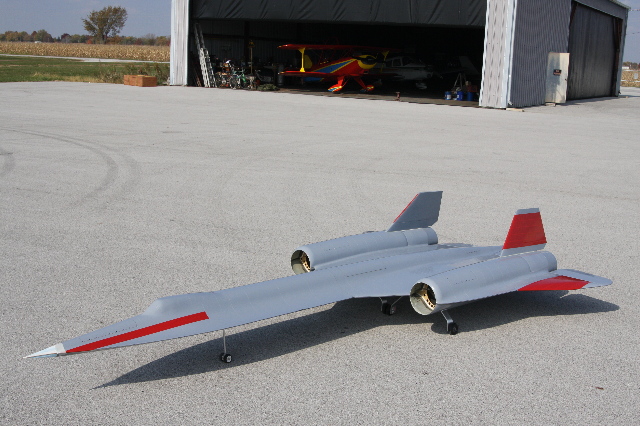
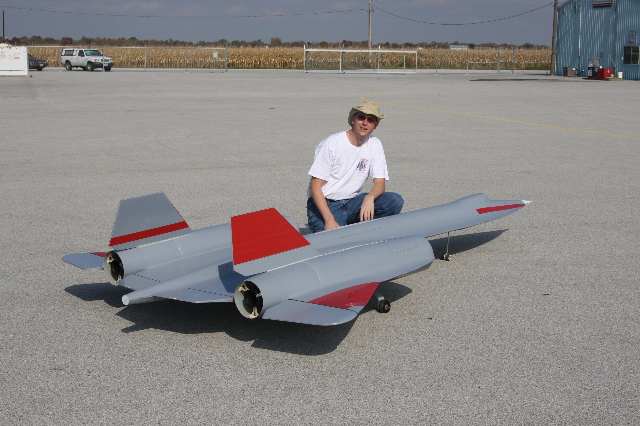
Below you'll find a few runway shots, and video of the 2nd flight of the day. Thanks to Vern for shooting the video. It's not easy shooting models in the air, much less jets, but Vern has done a good job shooting all the test flights to date.
Next up are several elements of the project. The molds need to be made for the tip of the nose and tip of the tail, engine ducting needs to be created, and the real landing gear needs to be constructed. Stay tuned....

Head back to the Main Page